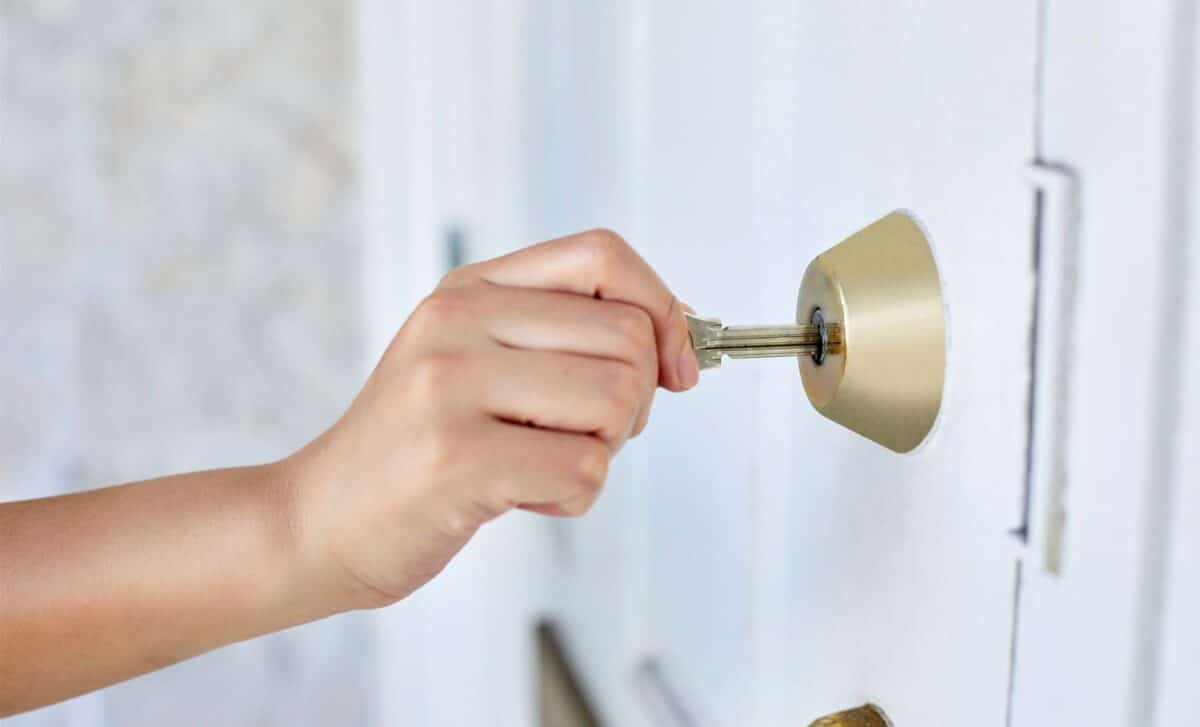
Many people leave their key in the door lock before going to sleep. It feels practical, reassuring, and it can also make it easier to leave quickly in an emergency. Still, security specialists say this habit may create a few problems, especially with modern locking systems. Between mechanical wear and a false sense of security, the issue is more complex than it seems.
Your Lock Can Wear Out Faster
Inside a standard door lock, several small metal components work together with tiny springs. When the correct key is inserted, these parts align properly and allow the cylinder to turn so the door can open.
When a key stays inside the lock all night, some of those springs remain under pressure for hours. In the short term, this usually causes no visible damage. Over time, though, especially with an older or heavily used lock, the constant tension can gradually wear down the mechanism.
This may lead to a key becoming harder to turn or a cylinder starting to jam occasionally. Modern locks are designed to handle years of daily use, but specialists point out that any mechanical system exposed to continuous pressure will eventually lose some efficiency.
The overall quality of the lock also matters. A high-end cylinder will usually tolerate this type of use better than an older or cheaper model that has already seen years of wear.
This Unexpected Kitchen Waste Keeps Slugs Away Effectively, Here’s How To Use It!
Leaving the Key Inside Does Not Always Improve Security
A common belief is that leaving a key in the lock prevents burglars from opening the door from the outside. That idea mostly comes from older locking systems, where an inserted key could interfere with certain break-in techniques.
Today, many modern locks are equipped with what is known as an emergency or dual-access function. This allows the door to be unlocked from the outside even if another key is already inside the lock. The feature is designed to prevent accidental lockouts and make emergency access easier. As a result, leaving a key inside the door often provides far less additional protection than many people assume.
In reality, a door’s resistance depends much more on the quality of the cylinder, anti-burglary protections, and the overall strength of the door itself. A key left inside the lock is rarely a decisive security factor.
At the same time, many homeowners still lock their doors at night because insurance policies may require the property to be properly secured in case of a burglary. Keeping the key already inserted can also help people evacuate faster during an emergency such as a fire.
Modern Alternatives Are Becoming More Popular
To avoid choosing between convenience and safety, several alternatives have become increasingly common in recent years. Some locks now include an interior thumb-turn, allowing the door to be unlocked quickly from inside without needing a key.
Panic locks work in a similar way and are designed so the door can be opened instantly from the inside, even when fully locked. Smart locks are also growing in popularity. Some systems allow users to unlock the door using a smartphone, a keypad, or a fingerprint scanner. Others completely replace the traditional cylinder, removing the question of leaving a key inside altogether.
These solutions can offer more convenience, although they also require some maintenance, including battery charging and occasional software setup.